Visual Art

line dance for an american textbook

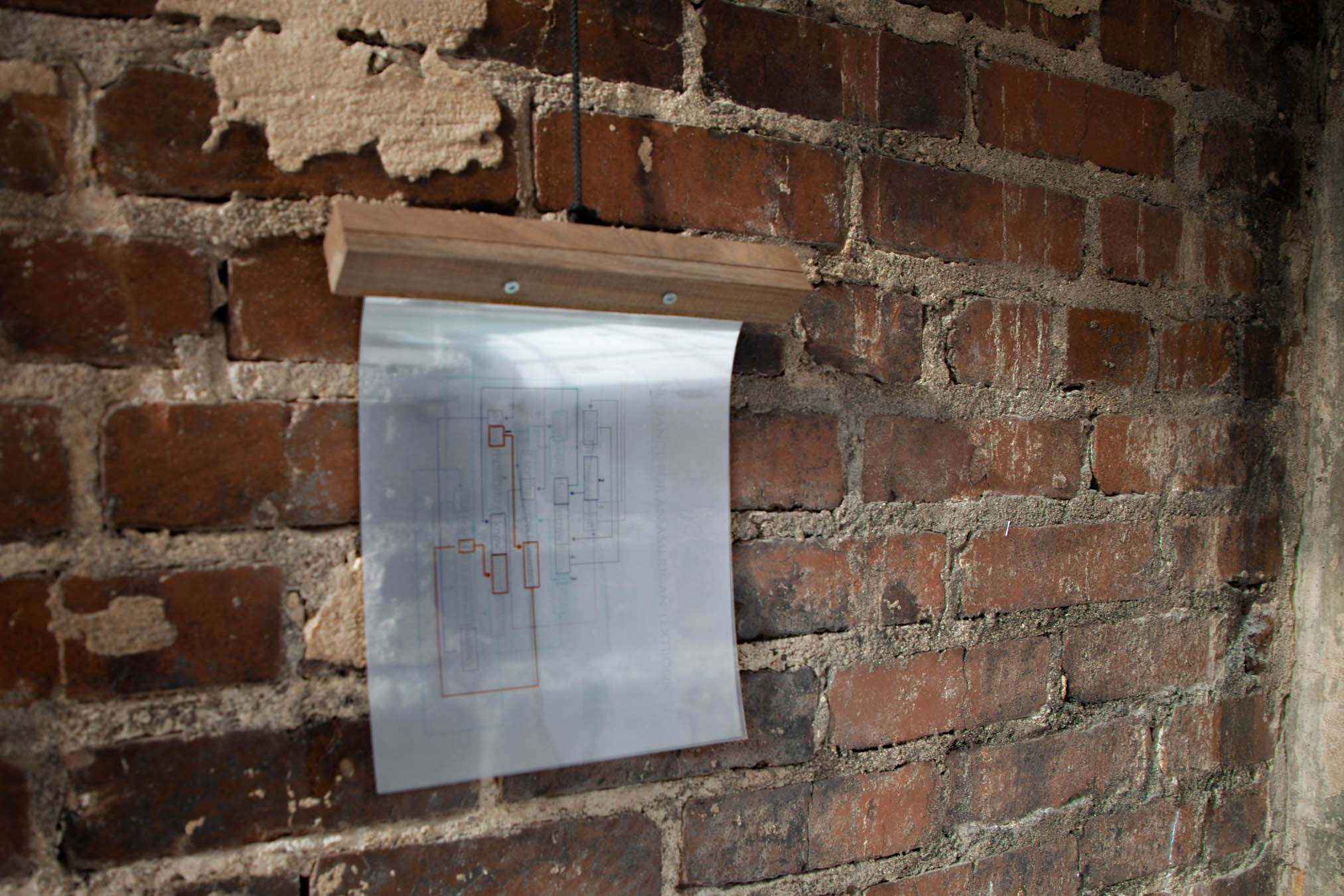
8.5 x 11 x .5 inches, Transparencies and wood

This visual poem functions as both a window and a bound book. When the book is “closed,” it reads something like a traditional poem (left to right, top to bottom). The subject of this version of the poem is about looking at a family photograph. But by flipping the pages, lines directing the reader to examine the words in a different set of “steps” are made legible, and a new poem is recovered—this one about America’s history of violence and erasure.

Thought-Terminating Cliché

4.8 x 3.23 x 0.59 inches, Wood (Reclaimed Puzzle)

A thought-terminating cliché is a phrase used by someone to shut down dissent, investigation, or further discussion. Whether or not it is done instinctually, a phrase like “it is what it is,” or “that’s just my opinion” is a kind of conversation closer.

This is a sliding puzzle, a simple kind of combination puzzle (like a Rubik’s Cube).

It has a solution but I am much more interested in what is beneath/beside/beyond that solution.

White Flight

A close-up photo of a poetry objected called White Flight. Two 3x3 checker-patterned boards are connected at one corner. Most of the checkered squares have white pawns on them: black on one side and white on the other. A line of squares going down the center of the board have no pawns on them, and 4 of the 5 squares, have circles with words burned under them. The only one that is in focus is the word "good." Everything sits on a wooden table.

9 x 9 inches, Wood and reclaimed chess pieces

This is based on a puzzle by Rouse Ball’s Mathematical Recreations and Essays.

The instructions are, essentially, as follows. Set up the board so the top left portion is filled with white pawns (8), and the bottom right with black pawns (8). A move consists of moving a piece horizontally or vertically into a space, or jumping over one adjacent piece into the space just beyond the jumped piece. No diagonal moves are allowed, nor is moving backward. The challenge is to exchange all the black pieces with all the white in the fewest possible moves.

It has a solution but I am much more interested in what is beneath/beside/beyond that solution.

Photography

A dark photo of an apartment. The left side of the photo shows the entrance to another room with a yellow painted wall and white light switches. The main room contains a very tall bookcase on the left, and a shorter one on the right, both filled with books. The right-most wall has hanging photos. The center of the room has a long dining table with plates, a puzzle, and other papers on it. At the far back of the room is a mirror, barely lit. Standing in the doorway to another room is a brown-skinned man, shirtless, looking at the camera.
A photo, taken from a high angle, of an old-fashioend torn beige settee sitting in the corner of the room. The floor is dirty black and white checkered linoleum. The white wall appears very short. The wall on the left has an exposed white painted pipe. From the top of the image coming down are the black diagonal beams of the rafters.
A very close-up photo of a brown skinned man's bearded chin, stubbled neck, and bare shoulder. In the background a white-lit window.
A photograph of a brown hand in triangular light. All else is in shadows too dark to see, besides a green leaf glowing at its edges on the left side of the photo.
A photograph of an orange, partially peeled. A diagonal line of light cuts behind, and partially over the orange, causing the flesh to seem to glow. In the light, out of focus, are the remaining peels. The shadows above and below the orange make it too dark to make anything else out.

Apology Series, Digital Photography, 22″ x 14″

Runner-Up, Boynes Emerging Artist Award